
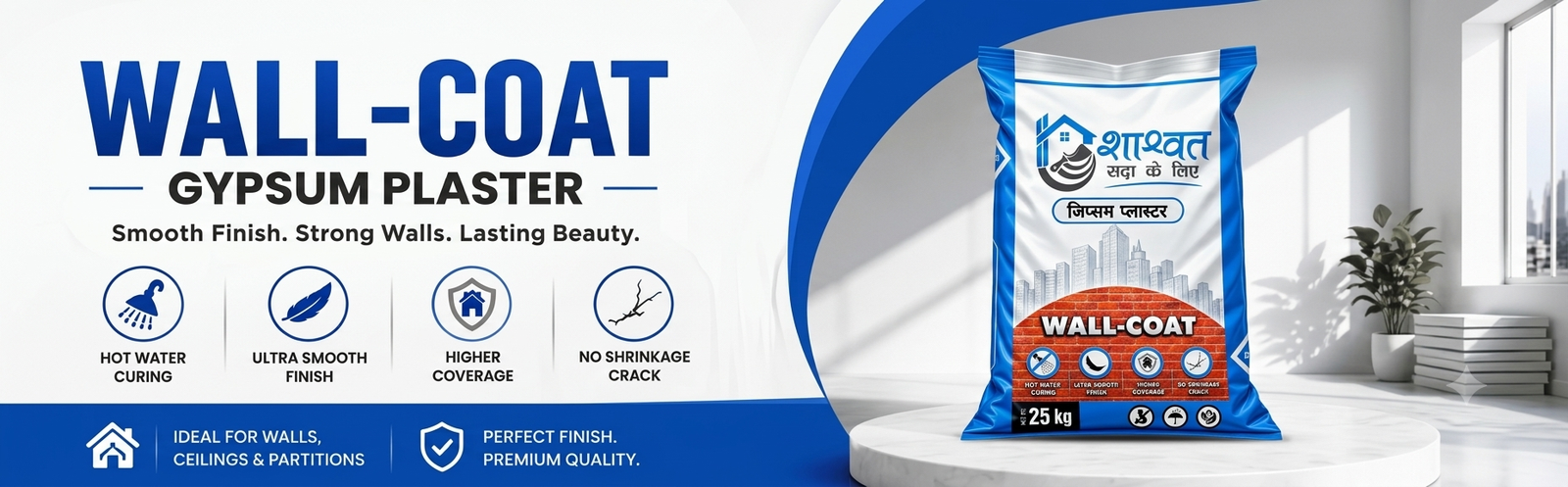
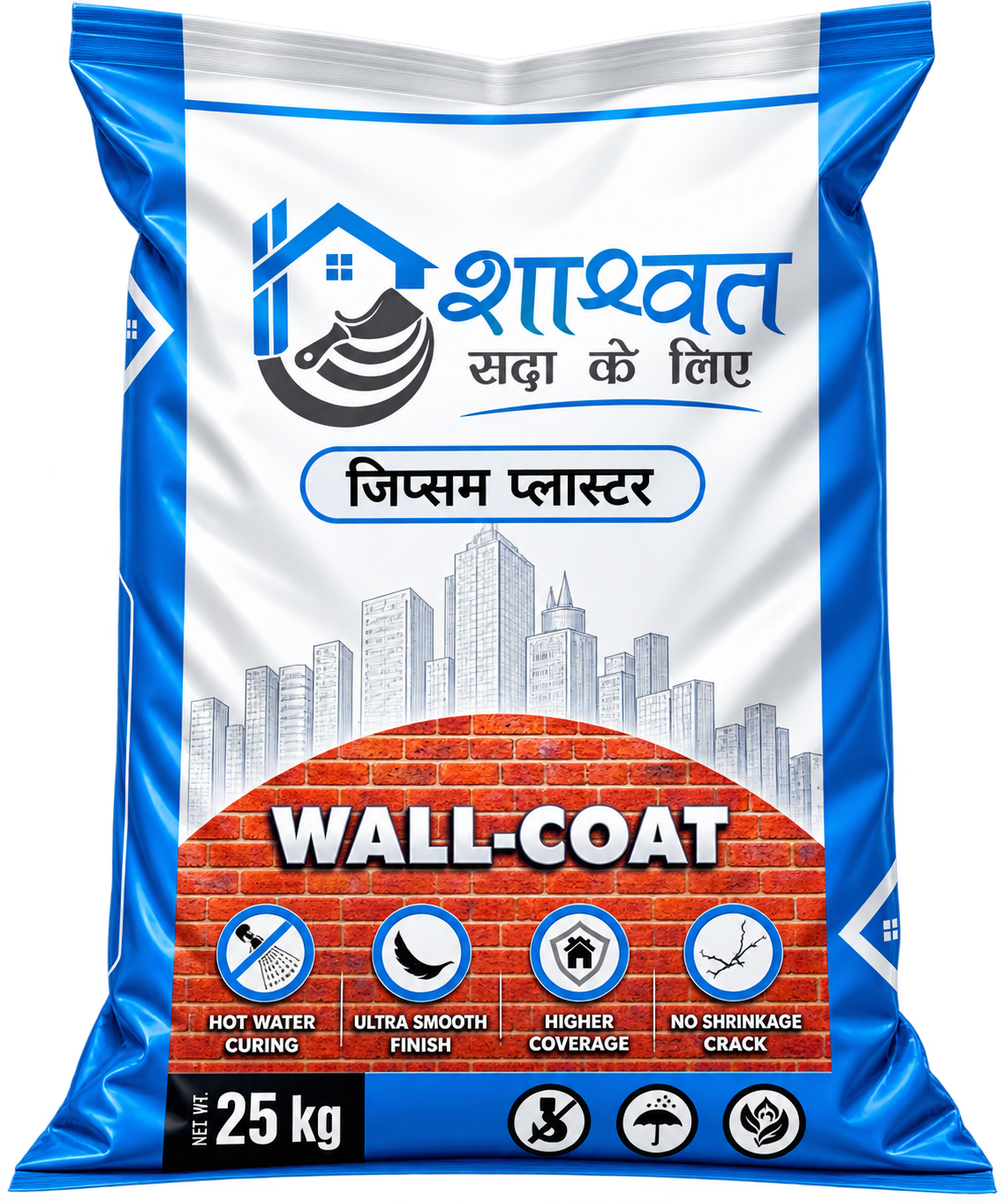
Shashwat Wallcare Wall-Coat Gypsum Plaster is a super-fine, ultra-smooth finishing plaster specially developed to deliver a velvet-like, luxurious surface on interior walls and ceilings. Engineered with refined gypsum and advanced additives, it offers exceptional whiteness, perfect levelling, and flawless smoothness, making it the ideal choice for modern, elegant interiors.
Designed as a final finishing coat, Wall-Coat Gypsum Plaster transforms ordinary plastered surfaces into premium, paint-ready walls with unmatched finesse and durability.

Super-Fine
Particle Size
Extra White
Appearance
Velvet-Touch
Surface
Excellent
Workability
Lightweight for
Ceilings
Perfect Base for
Paints
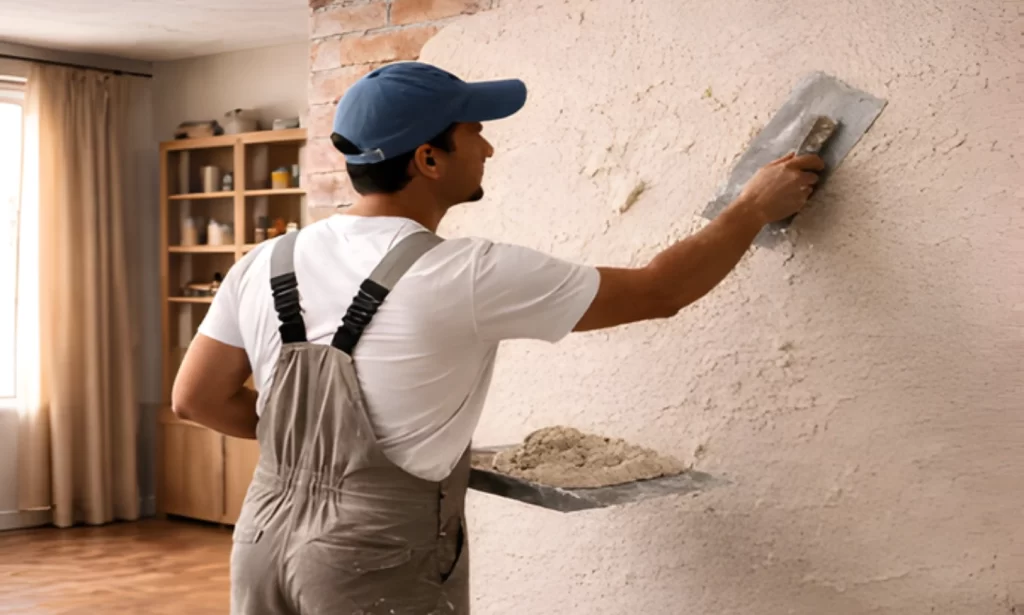
Modern in nature, Wall-Coat Gypsum Plaster is a wall finishing product that is mainly used to prepare walls and ceilings for painting. Natural gypsum is the primary component of this product, and it is combined with special light-weight minerals like vermiculite. Subsequently, these materials are thoroughly ground to form a powder. This powder is then mixed with clean water to form a smooth paste just before application.
The finished layer of Wall-Coat Gypsum Plaster is a strong and even surface that is smooth. The new paint or decorative finish is of a better quality than before and the application of the plaster wall has not been made so easy already. And the whole process is placed in less time than drying times for cement plaster.
The product is normally referred to as the base coat and it mainly provides necessary leveling and surface defect hiding for things like cracks, rough patches, and small undulations. Besides, it does so while at the same time not harming the structure much because of its light weight and actually improving the indoor comfort.
Wall-Coat Gypsum Plaster finds its way into modern houses, condos, offices, hotels, hospitals, schools, as well as commercial spots. It allows for quicker construction and does not compromise on quality in terms of the clean, professional finish.
Wall-Coat Gypsum Plaster is a product that comes with many advantages and features which are helpful modern constructions as well as renovation projects.
Smooth and Uniform Finish
With this plaster, it is possible to achieve a flat and level surface. It can hide rough masonry work and prepare the final finishing coats on the wall.
Lightweight Material: Wall-Coat Gypsum Plaster is very light compared to cement plaster due to the presence of vermiculite. This leads to a reduction in the load on the walls and ceilings.
Easy to Apply:
The mixing and spreading of the plaster are simple and do not require advanced techniques. Basic plastering tools can be used for its application.
Fast Setting and Drying:
Wall-Coat Gypsum Plaster is faster than the traditional plaster in setting time. Thus, it is an accelerator of construction and renovation works.
No Water Curing Required:
This gypsum plaster does not need water curing as cement plaster. Therefore, it consumes less water, time and labor.
Good Thermal Insulation: Vermiculite helps in making thermal insulation better. That is, air conditioning in summer and heating in winter are not needed to such an extent.
Sound Absorption: The plaster plays a role in decreasing sound transmission which makes the indoors quieter and more pleasant.
Fire Resistance: Gypsum possesses natural fire-resistant characteristics. This enables the inside of the building to be safer.
Crack Resistance: Wall-Coat Gypsum Plaster, if applied correctly, will minimize the occurrence of shrinkage cracks.
| Parameter | Specification |
| Color of Finished Surface | White |
| Density | 750–775 kg/m³ (Max) |
| Setting Time | 20–25 Minutes |
| Compressive Strength | 3–5 N/mm² |
| Transverse Strength | 30–45 kg/cm² |
| Water to Material Ratio | 1 : 1.5 |
| Coverage | 0.75–0.85 sq. ft. per kg (15 mm thickness) |
| Shelf Life | 12 Months |
Unquestionably, Wall-Coat Gypsum Plaster implies several practical and long-term benefits.
1. Superior Wall Finish
It forms a velvety smooth surface that imparts a higher aesthetical quality to the ensuing paint or decorative coatings.
2. Faster Project Completion
Rapid setting and quick drying times minimize the waiting period for the painting after the plastering process.
3. Water Saving
No curing means a considerable reduction in water use, which is very crucial in areas that are not so fortunate in terms of water supply.
4. Lower Structural Load
The use of plaster that is lightweight cuts down the stress on the building’s foundation, beams, columns, and slabs.
5. Better Indoor Comfort
The combination of thermal and sound insulation works in favor of the comfort of the entire living and working area.
6. Clean Construction Process
Gypsum plaster is less dusty and dirty than cement plaster.
7. Cost Efficiency
Reduction of labor, water, and time all contribute to the overall project cost being minimized.
8. Long-Lasting Performance
Wall-Coat Gypsum Plaster applied correctly will be stable and last for years without any signs of wear
Wall-Coat Gypsum Plaster is of great help in many building sections where smooth base surface is the foremost requirement.
Fixtures in the interior walls of a building are a classic case of the usage of Wall-Coat Gypsum Plaster. The plastering is done in:
It masks the imperfections in masonry and gives a flawless surface for paint, wallpaper, or textured finishes.
Wall-Coat Gypsum Plaster, although suggested primarily for interiors, is nevertheless an exterior material. Its use outside is restricted and should be confined only to areas that receive no direct rain and are adequately protected from moisture. It is a prerequisite to have totally waterproofing and weather-resistant coatings for outside applications.
Old walls frequently develop cracks, rough patches and crumble plaster. Wall-Coat Gypsum Plaster is most suited for renovation and repainting projects. It has the ability to repair defective surfaces and to prepare them for fresh paint without tearing down the entire structure.
When it comes to ceilings, using Wall-Coat Gypsum Plaster is a wise decision. Its lightness means less weight on the slabs and the provision of a smooth ceiling finish to resonate through the dielectrically behavior of room. The product also adds to the good quality sound absorption and thermal comfort in the rooms.
The proper application guarantees the connection strength and the smoothness of the final product.
Step 1: Surface Preparation
The first thing to do is to clean the surface very well.
You have to get rid of all the dirt, dust, loose particles, and oil, and also remove old paint.
Moreover, you should fix the cracks or holes that are very deep.
Then, make sure that the surface is dry and stable.
Step 2: Mixing the Plaster
Put some clean water into a bucket.
Gradually pour Wall-Coat Gypsum Plaster powder into water.
Using a trowel or mixer, combine it really well.
Make a paste that is smooth and without lumps.
Step 3: Applying the Plaster
Plaster must be applied with a steel trowel.
Work from the bottom up.
The thickness of the layer should be the same all over the surface.
Step 4: Levelling
The surface should be levelled with a straight edge or with a trowel.
Low spots must be filled correctly.
Plaster surplus should be removed.
Step 5: Final Smoothing
During the first setting of the material, smooth the surface.
To achieve uniformity in finish, use long strokes.
Step 6: Drying
Let the plaster dry by itself.
Refrain from watering.
The drying time is affected by the temperature and humidity.
Gypsum plaster is a modern construction material derived from naturally occurring gypsum. It serves as an excellent alternative to traditional cement plaster for interior walls and ceilings, offering a glass-like finish and durability without extra effort.
This plaster is formulated with high-quality refined gypsum and lightweight minerals like vermiculite. It also contains specialized bonding agents and additives that ensure superior adhesion and a long-lasting, lustrous finish on your interior surfaces.
This product is known for its quick application, typically setting within a short window of approximately 20 to 30 minutes. It offers high-grade compressive strength, providing walls with a sufficiently solid and robust internal structure.
Application is straightforward. After cleaning the surface, a lump-free paste is prepared by mixing the powder with water in the correct ratio. It is then spread evenly using a steel trowel to achieve a perfectly smooth finish.
To cater to various construction needs, Shashwat Wallcare Gypsum Plaster is available in standard packaging sizes based on market demand. You can choose the most suitable option depending on your specific project requirements and volume.
This natural product significantly saves water as it does not require curing like traditional cement plaster. It is recyclable and eco-friendly, ensuring that your construction process has a minimal environmental footprint while saving precious resources.
Key benefits include a crack-free, super-smooth surface that eliminates the need for putty. It provides excellent thermal insulation to keep interiors cool, offers natural fire resistance, and significantly accelerates the overall project completion timeline.
Compared to traditional plaster, gypsum is much lighter, reducing the structural load on buildings. It saves water, requires no putty, and provides a much more premium, uniform, and aesthetically pleasing finish for modern interiors.
Ensure the wall surface is completely dry, clean, and free from dust or grease. Any existing dampness should be treated beforehand, and always use clean water to prepare the mixture to achieve the best possible results.
Yes, it bonds exceptionally well to both rough brickwork and smooth RCC surfaces. It effectively masks imperfections on any type of interior wall, transforming them into a perfectly level and professional-looking surface for your home.
Store bags in a dry, cool place away from any moisture. Keep them elevated on wooden planks rather than directly on the floor, and ensure the packaging remains tightly sealed until it is ready for immediate use.
For a flawless finish, the “level-to-smooth” technique is recommended. Apply a single coat to level the wall, followed by long-stroke finishing before it sets to achieve a silky, reflective surface that is ready for painting.
You can reach out via the toll-free number or email provided on the official Shashwat Wallcare website. Direct inquiries are also welcome at their corporate office located in New Delhi for personalized assistance regarding products.
Shashwat Wallcare provides comprehensive technical guidance to its customers. You can access advice on the official site or request assistance over a call to understand the correct mixing ratios and professional application methods.
The website features WhatsApp chat and instant query forms for your convenience. You can submit your questions online, and our support team will get in touch shortly to provide effective solutions for your concerns.
The company offers technical guidance and on-site support throughout the project. This includes training on proper mixing, professional techniques, and periodic quality checks by supervisors to ensure a world-class finish for your walls.
Detailed application guidelines and safety instructions can be obtained by contacting a company representative directly. Additionally, essential precautions and usage methods are clearly printed on the packaging of every gypsum plaster bag for easy reference.
Yes, for large-scale projects or bulk requirements, Shashwat Wallcare offers on-site product demonstrations. You can send a request to the sales team, who will arrange a demo to showcase the product’s superior quality and finish.
Gypsum plaster requires very low maintenance. Once properly painted, it stays in excellent condition for years. To ensure its longevity, simply protect the walls from direct water leakage or persistent internal dampness from plumbing issues.
A dry cotton cloth is best for removing surface dust. For light stains, a slightly damp cloth can be used gently. Avoid scrubbing the surface harshly or soaking it with water to maintain the premium finish.
Absolutely. Gypsum plaster is specifically designed to be directly paintable. Its high whiteness and smoothness enhance the final appearance of the paint, resulting in a vibrant look while significantly reducing overall paint consumption.
If the plaster becomes wet, identify and stop the source of moisture immediately. Allow the surface to dry naturally. Check for any structural changes; if bulging occurs, that specific section might require professional repair.
Minor cracks are easily fixed by cleaning the affected area and filling it with a fresh paste of gypsum plaster. Once dry, lightly sand the surface to match the surrounding wall before reapplying the paint.
Avoid using gypsum plaster in areas with constant water exposure or extreme humidity. It is primarily intended for dry interior surfaces and should always be protected from direct rain, external moisture, and waterlogging conditions.
Yes, on well-prepared even surfaces.
Yes — its extra white, smooth texture reduces paint usage.
Wall-Coat Gypsum Plaster acts as a barrier to make the wall painting process easier, quicker, and less tiring by improving the surface with a smooth and strong layer.
No way! Wall-Coat Gypsum Plaster and white cement are quite distinct in their material, composition, properties, and application areas.
Continuous moisture exposure or damp conditions caused by leaking water should be avoided areas unless proper waterproofing is done.
Vermiculite plasters are less heavy, provide greater insulation, and take less time to dry than traditional cement plasters, and they also contribute less to the total weight of the structure.
No, it is not the Wall-Coat Gypsum Plaster that is responsible for the waterproofing. If you want to avoid getting the walls wet in any way, a proper waterproofing system is required.
The biggest con of vermiculite is that it is quite moisture-sensitive, so it cannot withstand long periods of high humidity and needs to be protected from water entering the structure.
The minimum thickness at which plaster is applied generally varies from 6 to 8 mm, depending on how the surface is prepared.
Vermiculite plasters, characterized by their lightweight, good insulation, and environmentally friendly properties, require the application in protected dry places. Indoor comfort is enhanced, but they should be used in dry and protected areas.
Office No.1803, 18th Floor, Silver Wing, Wave One, Plot No.L-2A Sector 18, Noida, Uttar Pradesh-201301